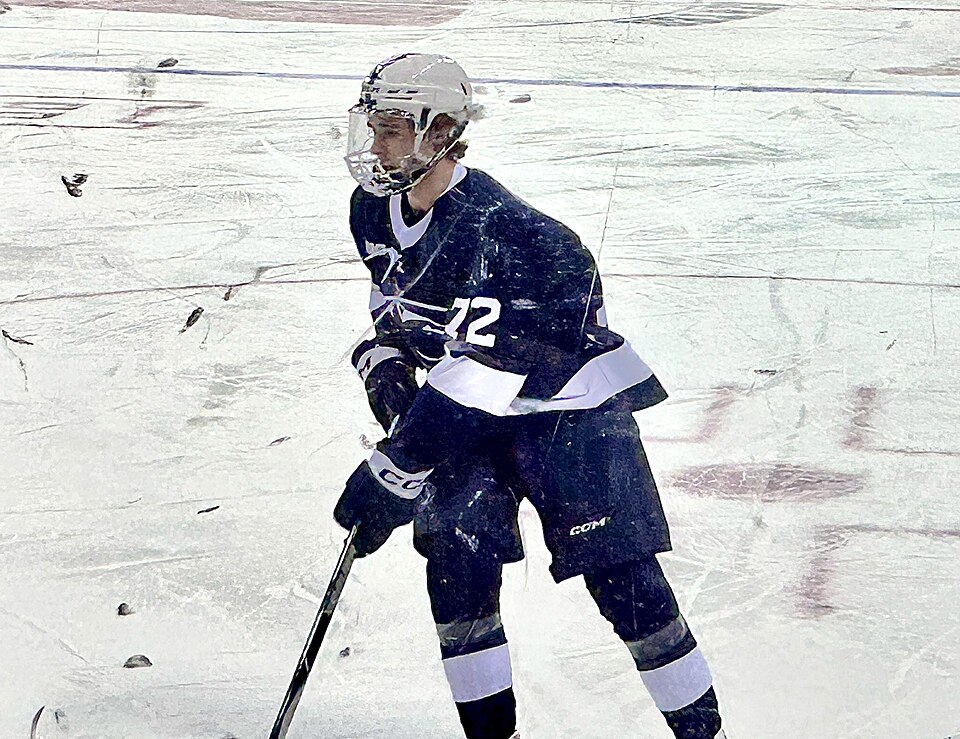
We are obligated, at some point in the lifespan of a truly exceptional hockey prospect, to say the thing plainly: what Gavin McKenna did in his freshman season at Penn State was not normal. Fifty-one points in 35 games, the Big Ten scoring title, a Penn State freshman record for points and assists that had stood since the program’s formative years, and — in case anyone needed a single-game crystallization of what the argument is about — eight points against Ohio State in February, the most in a Division I game in 39 years. Seven of those eight were assists, the most in any college game since 1983. You can debate individual statistics in any sport. You cannot debate a player making history in the context of his own conference in the middle of his first college season.
McKenna came to Penn State as the consensus top prospect for the 2026 NHL Draft, and he left his freshman year having settled every question that might have existed about whether the college environment would limit or reveal him. The college game limits players who succeed on physical tools that translate poorly — too strong for junior, not strong enough for the NHL, suddenly ordinary in the space between. It reveals players whose game is built on hockey intelligence, vision, and the ability to create from nothing. McKenna is the latter. At Penn State, surrounded by older, stronger, more experienced players, he was still the one who made things happen. The junior totals — 129 points in 56 games with Medicine Hat in 2024–25, a WHL season that included a 40-game point streak — were confirmation of talent. Penn State was confirmation of the real thing.
The scouting conversation around McKenna at 18 has settled around a word that scouts use rarely and carefully: inevitable. Not inevitable as in certain to succeed — nothing in hockey is certain — but inevitable in the narrower sense that his game, the structure of it, the intelligence at the center of it, is built to translate. He reads plays faster than the players around him, not slightly faster but meaningfully so, in a way that becomes visible once you know to look for it. He identifies options before most players his age have finished reading the situation, and he executes those options with a technical precision that has made opposing coaches in the Big Ten spend considerable time trying to figure out how to slow him down. Very few of them succeeded for long.
What the next year looks like for McKenna depends on where he is drafted and how quickly the organization that selects him wants to move. He is 18 years old. He will not arrive at a training camp this fall as a finished product, and anyone representing him as one would be doing him a disservice. The learning curve from here to a regular NHL lineup is significant — it involves a professional game that is faster and harder than anything he has faced so far, a conditioning requirement that college hockey only begins to approximate, and the inevitable moments of failure that define development at every level.
But the case for patience is also the case for optimism. McKenna has never needed more than one season to become the best player in any environment he has entered. He arrived at Penn State and won the Big Ten. He played junior hockey and led the WHL in assists the season prior. There is a pattern here that is not subtle, and the teams selecting at the top of the 2026 draft — the draft that is now weeks away — understand it. The debate, such as it is, was settled somewhere around the third time McKenna set a Big Ten record in the same season. The rest is paperwork.